


Does It Have Legs? Bringing Canine-Assisted Care into Humanitarian Mental Health
This blog is an abbreviated, plain‑language version of my MSc thesis in Humanitarianism, Conflict and Development, written five years ago. It was inspired by many months I spent working in refugee camps across Europe and the Middle East, where I repeatedly witnessed the calming, connective power of placing a puppy into a refugee’s hands—and the joy and pride adults and children took in working with calm, friendly adult dogs, teaching them simple tricks and routines. While the thesis drew on post‑conflict Uganda and reflected on the 1994 Rwandan genocide, in which around one million people were killed.
The core framework for canine‑assisted interventions (CAIs) is designed to be culturally adaptable and scalable. In practice, that means it can be co‑created with communities and applied in any post‑conflict or displacement setting as a low‑cost, ethical complement to overstretched clinical services—meeting people where they are to rebuild calm, connection, and social trust. Such a project now exisits! The Comfort Dog Project.
In humanitarian crises, we talk a lot about trauma, clinics, and counseling. But what if one of the most effective tools for rebuilding mental health and social connection is already by our side—on four legs? This piece explores whether Canine-Assisted Interventions (CAIs) could fit inside today’s Western-shaped psychosocial playbook—specifically in post‑conflict Uganda—and what it would take to make them work. As a canine professional who has worked in refugee camps, I’ve witnessed the shift that happens the moment a puppy settles into someone’s arms: shoulders drop, breathing slows, and a guarded face softens. Those moments inform the argument you’re about to read.
Why Uganda? These realities are endemic to most post-conflict zones.
The victim–perpetrator duality describes how children abducted or recruited by armed groups can be both survivors of grave violations and, under coercion, participants in violence. Often controlled through fear, indoctrination, and drugs, they may be forced to commit acts—including sexual violence—that violate their values, leaving deep trauma and moral injury. When conflict ends, these youths return to communities they may have harmed, facing stigma and fear
Critical shortages: Fewer than one clinical psychiatrist per million people and minimal mental health infrastructure.
Young and disenfranchised: 78% of Ugandans are under 30; unemployment is high. Beyond past violence, daily stressors—poverty, boredom, isolation—drive today’s distress.
Cultural reality: Many Ugandans, especially in Acholi communities in the north, experience mental health collectively, not individually. Stigma is real; help‑seeking for “mental illness” is rare.
The Problem with One-Size-Fits-All Trauma Care
For decades, humanitarian mental health has leaned on Western diagnostic tools (notably PTSD) and individual therapy. That brings three risks:
Decontextualising distress: Focusing on wartime events while overlooking the crushing daily hardships after war.
Cultural mismatch: An individual, clinic-centred model within collectivist cultures can overlook how people actually understand and express suffering (often through bodily pain and spiritual frames). ie: does the community really need Westerned trained care professionals leading talk-therapy when for thousands of years these people would have relied on community elders and ancient practices for help.
Fragile participation: Programs designed afar, delivered briefly, and withdrawn quickly (“hit‑and‑run” aid) can undercut local confidence and community ties.
Eyewitness note: In camps, I repeatedly saw people avoid clinic tents but wander over to watch a calm dog. Within minutes, they were petting, breathing easier, and—crucially—talking to neighbours again.
Why Dogs?
Humans and dogs have co‑evolved for millennia. Around the world, spending time with dogs is linked to:
Physiological shifts: steadier heart rate, calmer breathing, lower stress reactivity, and increases in oxytocin through simple gaze and touch.
Social effects: less isolation, more conversation, more pro‑social behaviour, and community “glue.” Dogs act as social lubricants and gentle safety signals for hyper‑vigilant nervous systems.
Crucially for humanitarian work:
No shared language needed. Human–dog signals (facial cues, tone, posture) are intuitive.
Low barrier to engage. Dogs invite participation from people who avoid clinics.
Community ripple: A dog can spark interaction beyond a therapy room—on doorsteps, paths, markets—where social capital is rebuilt.
But Isn’t Pet‑Keeping a Western Thing?
Not entirely. Attitudes toward dogs vary widely by culture, faith, and local history, and “family‑member” pets are not the global default. In Acholi contexts, dogs also appear in spiritual and symbolic ways. The point isn’t to import “pet culture,” but to co‑create dog–human activities that fit local meanings—if we listen first.
Where Evidence Stands
Practice has outpaced research. There’s promising physiological data and abundant positive reports, but we still need stronger, culturally grounded trials—especially outside the West.
Signals from related settings—refugee programs, youth groups, prisons—show reductions in anxiety, loneliness, and aggression, and increases in empathy, responsibility, and social engagement.
Designing CAIs that Fit
To work in post‑conflict, low‑resource settings, CAIs should be:
Community‑first: Move beyond clinics; bring structured dog‑human activities into homes, schools, and village spaces.
Culturally adapted: Co‑design with local leaders, faith figures, healers, elders and youth; align with specific communal values and spiritual understandings.
Inclusive and low‑cost: Use local “village” dogs and pups that would otherwise be streeties (not expensive purebreds). Pair with basic animal welfare, vaccination, and handler training. Most importantly, these dogs would be neutered to reduce strays and streeties.
Sustainable: Train local paraprofessionals (“train the trainers”), embed in schools and community groups, and measure ripple effects (trust, cooperation, participation), not just individual symptom scores.
A Simple Pilot Blueprint
Co‑create: Convene elders, youth, teachers, health workers, and faith leaders to agree goals, roles, and boundaries for dog interaction.
Prepare the dogs: Partner with local vets or animal welfare groups for health checks, vaccinations, parasite control, and basic temperament screening.
Train handlers: Recruit respected local adults and youth. Teach canine body language, consent cues (for humans and dogs), hygiene, and simple session structure.
Start small: Run group sessions in familiar spaces: 60–90 minutes of greeting, gentle grooming, short walks, simple games, quiet holding, and reflection.
Measure what matters: Track sleep and stress—but also school attendance, participation in community tasks, reductions in conflict incidents, and new cross‑household ties.
Grow roots: Graduates mentor new cohorts; integrate with schools, women’s groups, and public health outreach.
Ethics and Safeguards
Animal welfare: Non‑negotiable. Healthy, willing dogs only; rest periods; shade; water; positive reinforcement; never coercion.
Human safety: Clear consent and opt‑out options; basic infection control; gender‑aware grouping; cultural sensitivity (including dog‑free zones).
Do no harm: CAIs complement, not replace, urgent clinical care for severe cases. Build referral pathways and respect existing spiritual and medical practices.
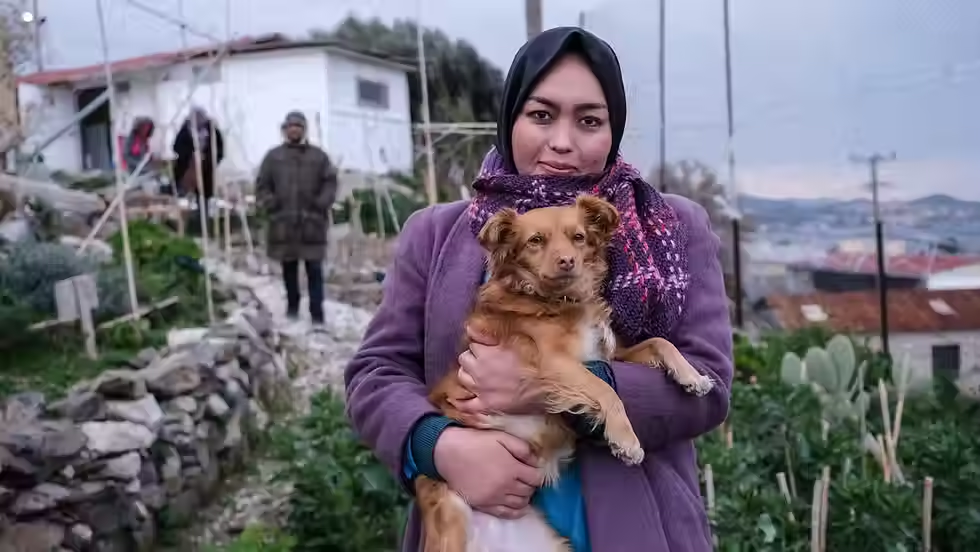
refugee camp on a Greek island
Eyewitness snapshots
I’ve seen a teenage boy, rigid and silent, exhale into a smile when a pup nosed his palm—within minutes, neighbours drifted over to discuss names and feeding. A tense courtyard became a planning circle.
I’ve watched women who kept their distance at first step in to show a child how to pet a dog gently. The conversation turned from fear to care, then to who could build a shaded spot and fetch water.
Does It Have Legs? Yes—if done with cultural humility, community leadership, and clear, ethical practice.


Comments